The Problem With Agency Websites That Look Like Agency Websites
Here's an uncomfortable truth about the digital agency market in India: most agency websites look like they were built by someone else's agency.
Same dark gradient background. Same service icons in a 3×2 grid. Same "We Build Digital Experiences" headline. Same testimonials section with five-star ratings and placeholder headshots.
The template era gave every agency a professional-looking website in 48 hours. But it also made professional-looking websites worthless as a differentiator. When your website looks like every other agency, the only thing separating you from the competition is price — and competing on price is a race to zero.
Arena Global Solution (arenaglobalsolution.com) had exactly this problem after their initial launch. The v1 website was well-built — good structure, decent performance, technically sound. But it looked like a template, because it started from one. And for an agency pitching premium web design and digital marketing services to businesses, that gap between what they promised and what their website demonstrated was silently costing them leads.
That's the design brief I walked into for the v2 redesign. Here's the full story.
---
Who Is Arena Global Solution?
Arena Global Solution is a full-service digital agency operating from Delhi with an international reach across New York, Dubai, and Toronto. Their service portfolio covers:
- Web Design & Development — custom websites, web applications, e-commerce
- App Development — mobile and cross-platform solutions
- Digital Marketing — SEO, paid media, social media campaigns, growth strategy
- Video Production — corporate films, brand reels, product videos
- Product Photography & Graphic Design — brand identity, marketing collateral
- SaaS & Technology Consulting — custom software for businesses
The challenge is positioning: each of these services requires a different type of trust from a potential client. A business hiring an agency for ₹50,000/month in digital marketing wants to see proof that the agency understands growth, data, and ROI. A startup hiring them for a website wants to see that the agency can build something visually spectacular. A corporate client buying video production wants to see taste and creative direction.
A generic template website satisfies none of these needs convincingly. The redesign had to satisfy all three simultaneously.
---
Before: What v1 Looked Like (And Why It Had To Change)
The v1 Arena Global Solution website wasn't bad. It had:
- A dark hero with gradient text and a CTA
- A services grid with icons and one-line descriptions
- A stats row (years of experience, projects, clients)
- A testimonials section
- A contact form
Functional. Credible. Forgettable.
The core problems with v1 were perceptual, not technical:
1. Template DNA Was Visible
The layout followed the standard agency template hierarchy with no meaningful deviations. A prospect who had visited even three other agency websites would recognise the pattern. Familiarity signals safety, but in premium B2B sales, familiarity signals commodity.
2. The Hero Sold No Vision
The hero section used a static gradient background with a headline. It communicated what the agency is, but not what it feels like to work with them or what calibre of work they produce. The first 3 seconds of a visit had zero premium signal.
3. Services Were Listed, Not Sold
The service cards described what Arena Global Solution does. They didn't show outcomes, communicate value, or create desire. A prospect reading "Digital Marketing" with a megaphone icon had no reason to think Arena was meaningfully different from the hundreds of other agencies offering the same service.
4. No Proof of Craft
An agency website is itself a portfolio piece. If the website is generic, the implicit message is: "this is the level of craft you'll get." That's fine for a budget-tier agency. It's disqualifying for an agency charging premium rates.
---
The Redesign Brief: Build a Website That Proves the Point
The goal of the v2 redesign was simple to state and difficult to execute:
The website should be so good that it becomes the first case study.
A prospect landing on arenaglobalsolution.com should think: "If they built this for themselves, imagine what they'd build for me."
This meant the redesign had to go well beyond visual updates. The entire experience — motion, interaction, layout hierarchy, content strategy, performance — had to communicate premium by demonstration.
Here's exactly what that meant in practice.
---
The Premium Redesign: Feature-by-Feature Breakdown
1. Three.js WebGL Particle Hero — The First 3 Seconds
The hero section is the most critical real estate on any website. It has approximately 3 seconds to create a strong enough impression to earn the next scroll.
For a generic agency, a bold headline and gradient background achieves "credible." For a premium agency, you need "impressive."
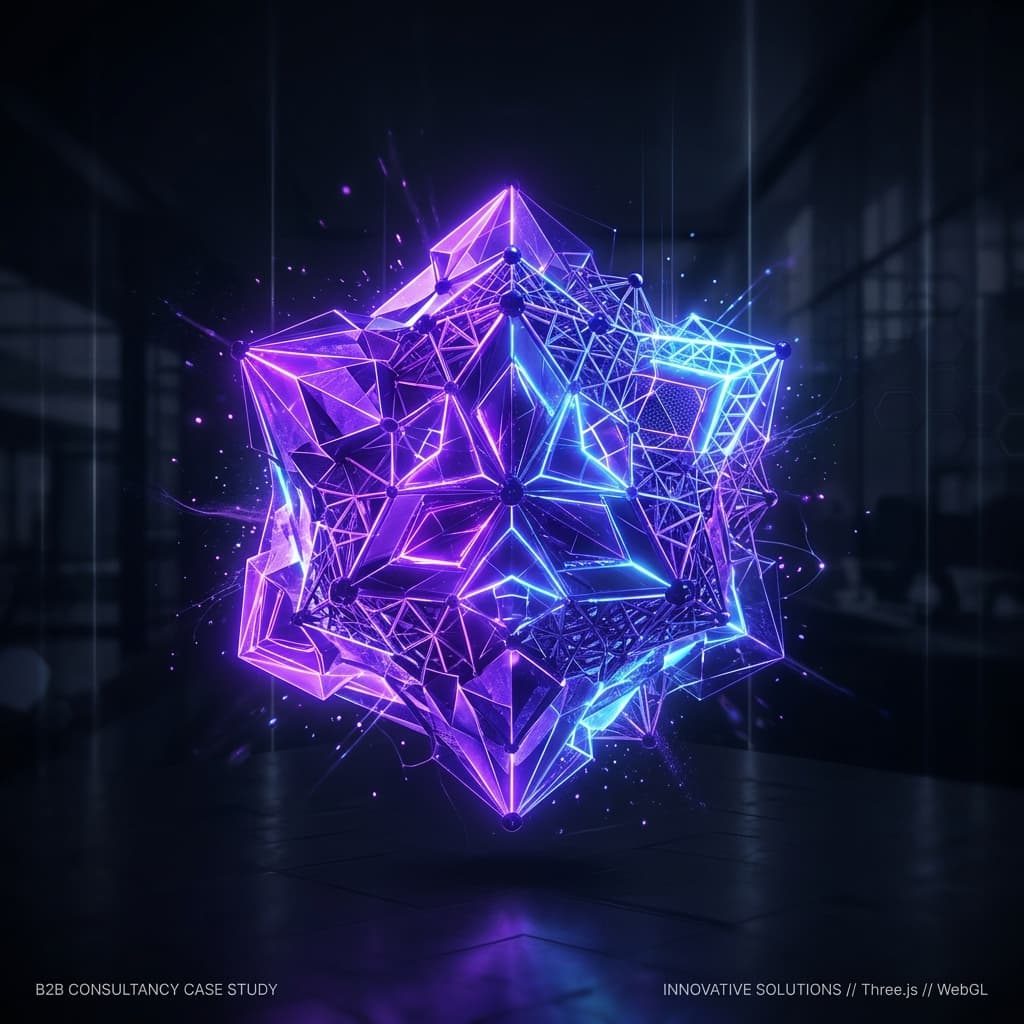
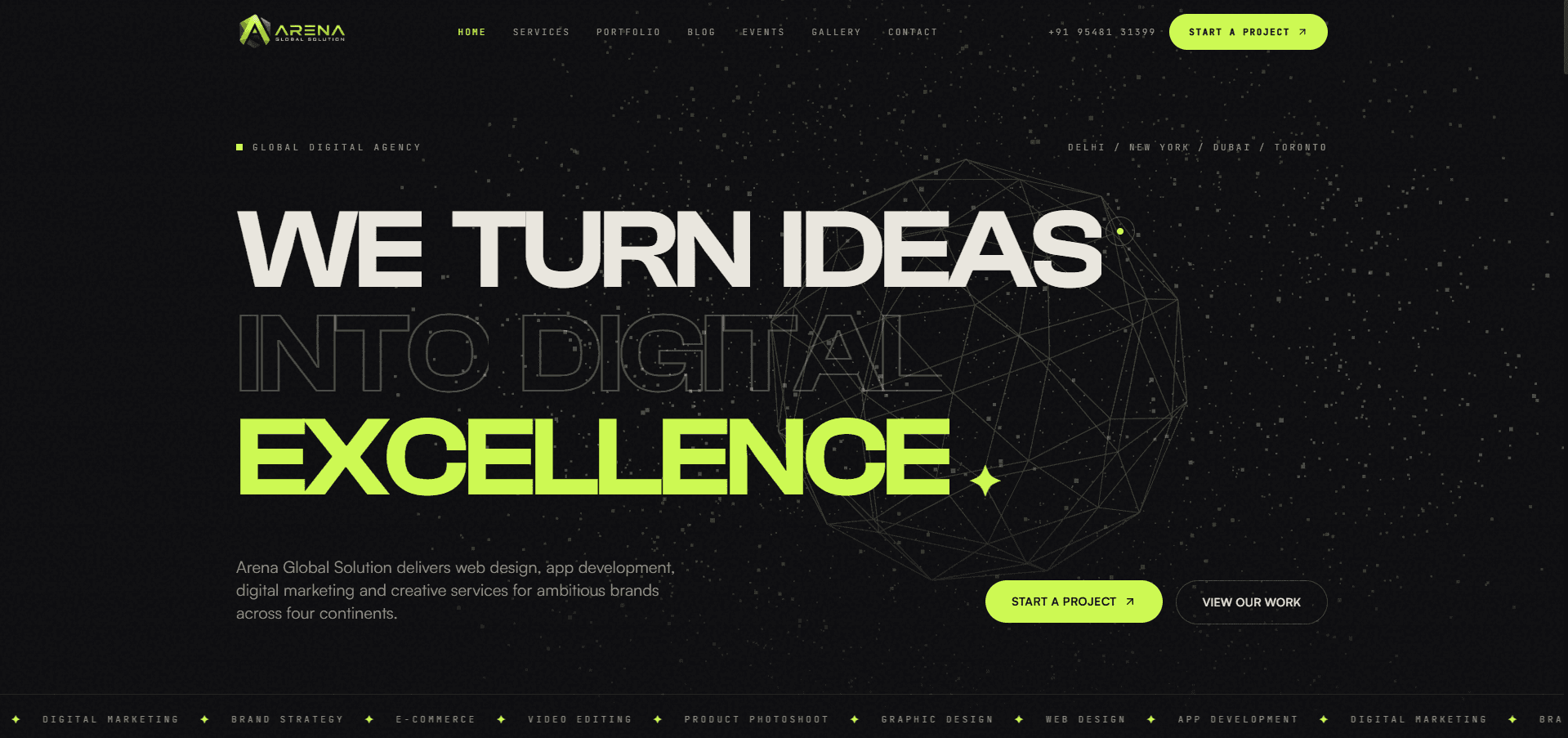
The v2 hero uses a Three.js WebGL particle field rendered via React Three Fiber. Thousands of particles float in three-dimensional space, responding to viewport — a living, breathing visual backdrop that immediately signals that this is not a template.
Why Three.js specifically?
- It communicates technical depth (an agency that understands 3D web graphics)
- It creates a premium visual signature that competitors can't replicate in 5 minutes
- It demonstrates the agency's actual capability — clients hiring them for web development see live proof of advanced frontend engineering
The particle system is lazy-loaded via React.lazy and Suspense:
const HeroCanvas = lazy(() => import("@/components/three/HeroCanvas"));
<Suspense fallback={null}>
<HeroCanvas />
</Suspense>This ensures the Three.js bundle never blocks the critical render path. The hero content (headline, CTA) renders immediately; the particle field loads in behind it.
The particle field is positioned in the right half of the viewport on desktop, creating a compositional division that gives the left-side text breathing room while the right side delivers the visual wow.
---
2. Custom Magnetic Cursor — Interaction as Brand Statement
A custom cursor is one of the most effective differentiators an agency website can have — and one of the most commonly done badly.
The v2 Arena Global Solution cursor is a magnetic cursor: a circular element that follows pointer movement with a physics-based lag, and when the pointer enters interactive elements (buttons, links, service cards), the cursor element is elastically attracted to their centre and morphs into a blend mode overlay.
Why does this matter beyond aesthetics?
- It makes the website feel different the moment a user moves their mouse
- It signals that the agency pays attention to micro-interactions — which is precisely what they sell
- It creates a memorable interaction signature: prospects remember the website because they remember playing with the cursor
The cursor is implemented entirely outside React's render cycle, using requestAnimationFrame for frame-perfect 60fps tracking:
// Vanilla RAF loop — never blocks React rendering
const lerp = (a, b, n) => (1 - n) * a + n * b;
const updateCursor = () => {
cursorX = lerp(cursorX, targetX, 0.1);
cursorY = lerp(cursorY, targetY, 0.1);
cursor.style.transform = `translate(${cursorX}px, ${cursorY}px)`;
raf = requestAnimationFrame(updateCursor);
};The linear interpolation (lerp) factor of 0.1 creates the characteristic trailing lag. On magnetic targets, the factor increases and the cursor position is pulled toward the element's bounding box centre.
---
3. GSAP Scroll Animations — Motion That Earns Attention
Static pages scroll. Premium websites reveal.
Every section in the v2 redesign has a purpose-built entrance animation powered by GSAP. The specific techniques used:
SplitText Character Animations
Headlines split into individual characters and enter the viewport in a staggered cascade — each character rising from below with a slight easing curve. This is the GSAP SplitText technique, and when it's tuned correctly (0.03s stagger, 0.9s duration, custom ease), it makes a heading feel like it's being written in front of you.
Staggered Service Card Reveals
The service cards enter with a stagger offset — each card delayed by 0.08s after the previous — creating the sensation of the grid assembling itself. Combined with a y-offset entrance (cards slide up from 40px below), this turns a grid into an animation sequence.
Scroll-Triggered Counter Animations
The stats block (projects delivered, clients, years, countries) uses GSAP's CountUp pattern: when the section enters the viewport, each number counts up from zero to its final value over 2 seconds. Numbers count up faster than text reads, creating a rhythmic visual energy in the stats row.
Parallax Depth Layers
Background elements shift at different rates to the foreground as the user scrolls, creating perceived depth. On a flat 2D screen, parallax is the closest you get to physical dimension.
All GSAP animations target transform and opacity only — these are GPU-composited properties that never trigger layout recalculation. The result is 60fps animations with no Cumulative Layout Shift (CLS) impact.
---
4. Lenis Smooth Scrolling — The Foundation Everything Else Sits On
Framer Motion and GSAP are visible. Lenis is invisible — and that invisibility is exactly its value.
Native browser scrolling has a momentum physics model that varies by OS, browser, and input device. On Windows with a mouse wheel, scroll is stepped and mechanical. On macOS with a trackpad, it's fluid. On mobile it's somewhere in between.
Lenis normalises all of this into a single smooth, linear scroll velocity that:
- Eliminates the stepped feel on Windows
- Provides a consistent base for GSAP ScrollTrigger calculations
- Makes the entire site feel like a polished product rather than a web page
The integration is straightforward but essential:
import Lenis from "lenis";
import { gsap } from "gsap";
import ScrollTrigger from "gsap/ScrollTrigger";
const lenis = new Lenis();
// Sync Lenis with GSAP's RAF loop
lenis.on("scroll", ScrollTrigger.update);
gsap.ticker.add((time) => lenis.raf(time * 1000));
gsap.ticker.lagSmoothing(0);Every GSAP scroll animation in the site fires from Lenis' smooth scroll position — not the native scroll position. This is what makes the scroll-triggered animations feel buttery rather than jerky.
---
5. Conversion-Focused Layout Architecture
Premium visual design gets prospects to stay. Conversion-focused layout gets them to act.
The v2 layout was restructured around a specific conversion intent for each section:
Hero → Qualify and Hook
The hero targets two audiences simultaneously: businesses who need a website (visual-led messaging) and businesses who need digital marketing (outcome-led sub-headline). The CTA is "Start a Project" — not "Learn More." Prospects who click learn more are curious; prospects who click "Start a Project" have intent. The CTA filters for the latter.
Brand Slider → Credibility Signal
The marquee of client brand logos immediately below the hero answers the question every prospect is asking within 10 seconds: "Who else has worked with you?" The horizontal scroll animation gives the brands visual momentum and prevents the section from feeling static.
Services → Value, Not Description
Each service card in v2 leads with a client outcome, not a service description. Instead of "Digital Marketing — We manage your social media and run paid ads," it's "Digital Marketing — we find the people who are already looking for you and put your brand in front of them." Outcome-first copy converts sceptics into enquiries.
Why Choose Us → Objection Handling
This section is positioned after the services deliberately. Once a prospect understands what Arena Global Solution offers, their next question is "but why you specifically?" The WhyChooseUs section answers the 4 most common objections: experience depth, delivery timeline, communication quality, and results transparency.
Contact Form Section → Friction Reduction
The contact form uses a conversational multi-step layout rather than a flat form. Instead of presenting 6 blank fields at once (overwhelming), it asks one question at a time: "What would you like to achieve?" → "What's your budget?" → "Tell us about your business." Progressive disclosure reduces form abandonment by making each step feel trivial.
---
Performance: 94 Desktop PageSpeed with Three.js + GSAP Running
This is the question every client asks when they see the Three.js hero and the GSAP animations: "But won't it be slow on mobile?"
The answer is: no, if you make the right architectural decisions. Here's the stack and what we optimised.
| Metric | Score |
|---|---|
| Desktop PageSpeed | 94 |
| Mobile PageSpeed | 82 |
| SEO Score | 98 |
| Accessibility | 92 |
| Best Practices | 96 |
How 94 Desktop was Achieved with Three.js + GSAP + Lenis Running:
1. Three.js Lazy Loading
The entire Three.js bundle (~750KB) is split into a separate chunk and lazy-loaded with React.lazy and Suspense. It never touches the critical render path. The LCP element (the headline) renders before Three.js even begins downloading.
2. GPU-Only Animations
Every GSAP and Framer Motion animation targets transform and opacity exclusively. These properties are composited on the GPU and never trigger layout or paint stages. Zero CLS, zero repaints.
3. Vite Code Splitting
Vite's production build splits the bundle by route — each page loads only its own component code, not the entire application. Lazy-imported heavy components (Three.js hero, Swiper carousel, heavy section components) are each separate async chunks.
4. Terser Minification
Production builds use Terser with tree-shaking to eliminate dead code. The final bundle is significantly smaller than the development build.
5. Cloudinary Asset Optimisation
All images are served via Cloudinary with q_auto/f_auto — automatic quality reduction and WebP format selection per browser. A hero image served as WebP at 70% quality is visually indistinguishable from a raw PNG at 15% of the file size.
---
SEO Architecture: Ranking on "arenaglobalsolution" and Digital Marketing Searches
The website was built with organic search in mind from the first component. Here's the SEO strategy:
Target Keywords
The primary target is the brand name: arenaglobalsolution and arena global solution. When prospects research the agency after a referral or seeing their work, the first thing they Google should surface a perfectly optimised result. The canonical URL, meta title, Open Graph data, and structured data all target this keyword.
Beyond brand searches, the site targets high-intent digital marketing and web design queries:
- digital marketing agency india
- web design agency delhi
- website design for businesses india
- digital marketing services india
- hire digital marketing agency india
On-Page SEO Implementation
React Helmet Async manages per-page metadata dynamically:
// Home.jsx
<Helmet>
<title>Arena Global Solution - Digital Excellence & Innovation</title>
<meta name="description" content="Transform your ideas into digital excellence..." />
<meta name="keywords" content="web design, digital marketing, app development..." />
</Helmet>Each page (Home, Services, Portfolio, Blog, Contact) has unique, keyword-targeted metadata. The services page targets service-specific queries; the blog targets long-tail informational searches from potential clients researching agency services.
Structured Data
JSON-LD Organization schema is injected in the root layout, giving Google rich context about Arena Global Solution: business type, location, service areas, contact information, and social profiles. This powers the Google Knowledge Panel for brand searches.
---
Who This Website Is For: The Client Profile
Arena Global Solution's target client is a business owner or marketing manager who:
- Already knows they need digital marketing or a website — they're not in the awareness stage, they're in the consideration stage
- Has been burned by cheap agencies before — they need to see premium signals before they'll trust another agency
- Has a meaningful budget — they're not looking for the cheapest option, they're looking for the right option
- Is making a decision based on gut and evidence — the gut response to the website should be "yes" before the case studies even load
Every design decision in v2 was made with this profile in mind. The Three.js hero, the magnetic cursor, the GSAP animations, the outcome-focused copy — all of it speaks to a prospect who has taste, who has standards, and who will immediately recognise when those standards are met.
An agency that builds websites for businesses needs to show that they understand business — which means they understand that the website is not a cost centre, it's a revenue generator. The v2 redesign demonstrates that Arena Global Solution understands this.
---
The Before/After: What Changed, Why It Matters
| Aspect | v1 (Before) | v2 (After) |
|---|---|---|
| Hero | Gradient background + headline | Three.js WebGL particle field |
| Cursor | Default browser cursor | Custom magnetic cursor |
| Scroll | Native browser scroll | Lenis smooth scroll |
| Animations | Basic fade-ins | GSAP SplitText + scroll-triggered reveals |
| Service copy | Description-first | Outcome-first |
| Contact form | Single flat form | Progressive multi-step layout |
| Mobile feel | Responsive but flat | Fully animated, app-like |
| First impression | "Professional agency" | "Premium agency" |
| PageSpeed desktop | 88 | 94 |
| Template visibility | High | None |
The change in "template visibility" from High to None is the most important metric on that list. When a prospect can no longer identify the template origin of your website, you've crossed the line from "professional" to "custom."
---
The Tech Stack: Why These Choices
const arenaGlobalSolutionV2Stack = {
framework: "React 18 + Vite 4",
styling: "Tailwind CSS + custom utility classes",
animations: ["GSAP 3.15 + ScrollTrigger", "Framer Motion 11"],
scroll: "Lenis 1.3",
threeD: "Three.js + React Three Fiber + @react-three/drei",
ui: "Radix UI (headless accessible components)",
routing: "React Router v6",
seo: "React Helmet Async",
bundler: "Vite 4 + Terser",
media: "Cloudinary (q_auto/f_auto)",
};Why React + Vite instead of Next.js?
The v2 site is a heavily interactive SPA. The primary value proposition is the experience — Three.js, GSAP, custom cursor, Lenis. These are all client-side concerns. Next.js adds SSR complexity and a larger footprint for a site that doesn't need server-rendered dynamic data. Vite's lightning-fast HMR made the development iteration speed dramatically faster when tweaking animation timings and Three.js particle parameters.
Why GSAP over pure Framer Motion?
Framer Motion is excellent for declarative component-level animation. GSAP is better for imperative, timeline-based, scroll-driven sequences. The v2 redesign uses both: Framer Motion handles route transitions and component mount/unmount animations; GSAP handles the complex scroll choreography where multiple elements need to move in coordinated timelines tied to scroll position.
Why Lenis?
Without Lenis, GSAP ScrollTrigger fires from native scroll events — which are stepped on Windows and inconsistent across devices. Lenis gives GSAP a smooth, consistent scroll value to work from. The result is animations that feel hardware-smooth on every device and every browser.
---
What This Means for Your Agency or Business
If you're running a digital marketing agency, web design studio, or any business that sells premium services — your website is your most powerful sales asset. And if it looks like a template, it's actively working against you.
The v2 Arena Global Solution redesign demonstrates something important: the budget for a premium website is not a cost. It's a lead generation investment.
Consider the math:
- Arena Global Solution charges ₹30,000–₹2,00,000+ for digital marketing retainers and website projects
- If the premium website converts even one additional client per month who would have otherwise bounced on the v1 site, the website pays for its own redesign cost in weeks
- Every client it wins after that is pure ROI
A website like this doesn't just look premium. It works premium — 24 hours a day, to every prospect who lands on it.
What Makes a Digital Agency Website Actually Convert in 2026:
- An unforgettable first 3 seconds — the hero must be impressive enough to earn the next scroll
- Proof of craft in the website itself — if you sell web design, your website is the pitch deck
- Outcome-focused service copy — prospects don't want to know what you do; they want to know what they'll get
- Micro-interactions that signal attention to detail — custom cursors, hover states, transition polish
- A contact form designed around the prospect's experience — not your data collection needs
- PageSpeed that doesn't embarrass you — 90+ on desktop, 80+ on mobile, regardless of how many animations you're running
---
Want a Website Like This for Your Business?
I'm Mohd Saif — a full-stack developer and UI/UX designer from Delhi. I designed and built every element of the Arena Global Solution v2 redesign: the Three.js hero, the GSAP scroll system, the custom cursor, the conversion layout, the SEO architecture — everything.
If you're running a digital agency, a consultancy, or any premium service business and your website currently looks like a template — or like it was built three years ago and never touched since — let's talk.
I build websites that work as hard as you do.
View the live site → · See my full portfolio → · Get in touch →
---
Mohd Saif is a Full-Stack Developer and UI/UX Designer from Delhi, India. He specialises in premium web design, Next.js, React, GSAP animations, and high-performance frontend development. He is the sole designer and developer of Arena Global Solution's v1 and v2 website.
Frequently Asked Questions
Got a project?
Safe & private. Privacy Policy